Smart eyewear OEM/ODM manufacturer · Shenzhen, China +86 19835872450 [email protected]
PRODUCTION SCHEDULE

Smart Glasses Lead Times, From First Sample to Container

A transparent schedule for planning: catalog samples ship in 5–7 days, branded pre-production samples in 10–15 days, and mass production runs 15–40 days by program tier after golden-sample approval. Below is the full timeline we quote against — samples, tooling, pilot, mass production and shipping overlay — including what can extend it and what we can do to compress it.

SAMPLE LEAD TIMES

Samples: 5–15 days for catalog and branded, 30–60 for custom ODM

The clock starts when the sample invoice is settled and all inputs — logo artwork, pantone references, firmware configuration — are in hand. The clock pauses while artwork or approvals are pending on your side.

Sample typeLead timeWhat is builtTypical use
Stock / catalog sample5–7 daysCurrent production SKU, factory configuration, sealed unitFit, audio, camera and app evaluation before committing to a program
Branded sample10–15 daysCatalog unit with your logo marking, custom color master and retail packaging mockupMarketing photography, retail buyer presentations, golden-sample drafting
Custom ODM sample (EVT)30–60 daysCustom PCBA or mechanical build, 3D/CNC parts, engineering verificationValidating a co-developed platform before tooling release

Sample lead time counts preparation only. Express door-to-door shipping via DHL or FedEx adds 3–5 working days to most destinations. Sample fees are charged at 1.5–3 times the mass-production unit price plus freight and are deductible from the first PO — full details are on the sample policy page.

5–7 daysstock catalog samples
10–15 daysbranded pre-production samples
30–60 dayscustom ODM EVT builds
3–5 daysDHL / FedEx transit on top
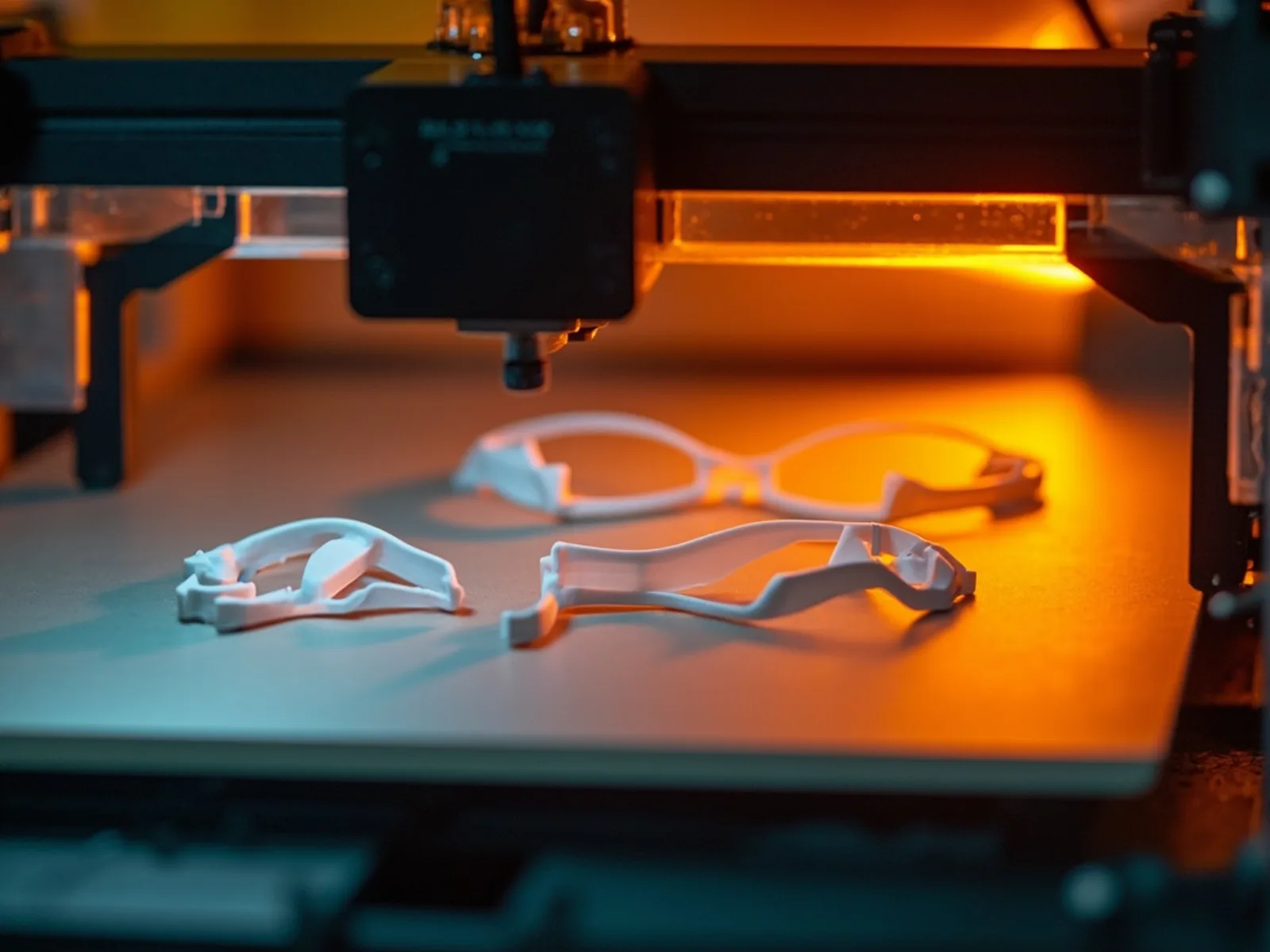
3D-printed and CNC smart glasses prototypes on an engineering bench
TOOLING & PILOT

Tooling 20–35 days, then pilot and PVT before bulk

Custom frame parts, hinges, optical windows and packaging molds require precision tooling. From approved 3D files, T0 first articles appear in 20–35 days, depending on cavity count, steel grade and surface finish. T1 samples are dimensionally checked and adjusted; mass-production steel is released only after you sign the golden sample.

Before the main run, a pilot / production validation trial (PVT) of 50–200 units proves the line: SMT yield, assembly cycle time, test fixtures and packing sequence. PVT typically takes 5–7 working days and is where packaging artwork and labeling are validated for the last time, so corrections cost hours instead of a full batch.

END-TO-END SCHEDULE

How a typical branded program lands in about 90 days

Illustrative timeline for a branded OEM program at 1,000–5,000 units on a reference platform. Catalog reorders skip tooling; custom ODM programs extend tooling and certification phases substantially.

Day 0–15

RFQ, DFM and deposit

Quotation, BOM confirmation, proforma invoice and 30% deposit; artwork and pantone masters collected in parallel.

Day 10–25

Branded samples

Logo marking, custom finish and packaging mockup built; units express-shipped for your evaluation.

Day 20–55

Tooling (if custom parts)

Mold design, cutting, T0/T1 trials and first-article inspection — 20–35 days, overlapping sample approval.

Day 45–60

Golden sample & certification

Sealed golden sample signed; CE/FCC/RoHS testing support completed or confirmed against existing certificates.

Day 55–65

Pilot / PVT

50–200 units validate yield, fixtures, firmware build and retail packing before bulk release.

Day 60–95

Mass production & QC

25–35 days of SMT, assembly, aging and AQL inspection with mid-line and final reports.

Day 90+

Packing & shipping

Export cartons, booking and 1–5 days handling before sea or air transit — see the shipping overlay below.

Dates overlap by design: tooling, certification and artwork run in parallel whenever inputs allow.

MASS PRODUCTION

15–40+ days, depending on how custom the program is

Mass-production lead time is counted from deposit clearance and golden-sample approval, not from the first inquiry. Reorders on frozen BOMs are faster because tooling, fixtures and test programs already exist.

Program tierMOQ fromMass-production lead timeDrivers
Catalog OEM500 units15–20 daysStock platform, logo marking only, existing test fixtures
Branded OEM1,000 units25–35 daysCustom color/finish, branded packaging, firmware configuration
Custom ODM3,000–5,000 units40–60 days after sample approvalNew tooling, custom PCBA, certification and reliability cycles

These are factory lead times under normal component availability. Peak season (August–October for year-end retail) can add queue time, which is why season-aware customers lock POs in June and July. The MOQ for each tier is explained on the MOQ page, and the full production process is described under OEM manufacturing.

ISO 9001 planningmaster schedules reviewed weeklyFrozen BOMno silent substitutionsWeekly statusphotos and gate reports by PM
PLANNING RISKS

What actually extends lead times — and who controls it

Rush-friendliness is mostly about removing unknowns early. The same factory that ships a reorder in three weeks can take three months on a first program when inputs move slowly. These are the four causes behind nearly every schedule slip:

01

Long-lead components

Custom displays, camera modules, specific SoCs and battery cells can carry 8–16 week lead cycles from upstream suppliers. We propose pin-to-pin or stock alternatives during DFM; selecting a catalog platform removes this variable entirely.


02

Certification cycles

CE, FCC, RoHS and REACH testing in your brand name normally takes 2–4 weeks after a passing pre-scan; one failed emission or battery test can add a full re-test cycle. Starting certification during tooling protects the schedule.

03

Artwork and approval delay

Logo vectors, dieline approvals, pantone masters and golden-sample sign-off sit on the critical path. Every week of artwork review adds roughly a week to delivery because printing and pad-print masters cannot start in parallel.

04

Peak-season capacity

SMT and molding capacity tightens from August through October, and sea-freight space does the same from September. Early POs and rolling forecasts let us reserve lines and book vessels before the queue forms.

Smart glasses assembly line running expedited production
EXPEDITE OPTIONS

When the launch date cannot move

  • Line priority — approved programs can be queued ahead of standard scheduling for SMT and assembly, typically compressing factory time by 5–10 days; feasibility confirmed case by case.
  • Parallel tooling — multi-cavity or expedited mold shops cut first-article time, and express courier for T1 samples removes postal lag.
  • Partial shipment — an air-shipped first lot (often 5–10% of the order) covers launch stock and marketing while the balance follows by sea at normal cost.
  • Air freight — 5–10 working days door-to-door versus 25–40 days by sea, with surcharges billed at actual cost; battery-bearing units fly under the regulated channels described on the logistics page.
  • Express samples — DHL/FedEx moves sample units to most countries in 3–5 working days, trackable from pickup.

Expediting changes cost, never quality: AQL inspection, aging and golden-sample conformance are not shortened to hit a date. Ask your PM for an expedite assessment with the launch date and quantity — the honest answer comes back within one working day.

SEASON PLANNING

Working backward from a retail launch

For a Q4 retail or Amazon peak, the most comfortable schedule places the deposit in May–June, golden sample in July, mass production in August–September and sea arrival in October–November. Spring launches follow the same logic in reverse.

T-16 weeks

PO and deposit; artwork, packaging and certification inputs locked.

T-14 weeks

Samples approved and golden sample sealed; tooling released if needed.

T-10 weeks

Pilot run complete; mass production starts with weekly gate reports.

T-6 weeks

Goods pass final AQL, ship by sea; documentation released against payment terms.

Holding a rolling forecast with us also buffers common components, shortening reorder cycles toward 15–20 days.

SHIPPING OVERLAY

Factory lead time is not door-to-door time

Production ends when goods pass final inspection — then logistics begins. Sea LCL/FCL from Shenzhen Yantian or Shekou typically takes 25–40 days to North America and 30–40 days to Europe; air freight runs 5–10 working days and express courier 3–7. Export documentation, battery paperwork (UN38.3, MSDS) and FBA labeling add 1–5 days of handling that we run in parallel with packing.

Incoterms range from EXW and FOB Shenzhen to CIF and DDP, so your landed-date planning should always quote factory lead time plus transit under the chosen term.

Container vessels and gantry cranes at Shenzhen Yantian port
Rows of smart glasses on aging racks during burn-in testing
WHY THE SCHEDULE HOLDS

Burn-in and gates are scheduled, not improvised

Aging, RF/audio verification and AQL inspection are built into the quoted lead time rather than promised afterward. Every lot completes power-cycle burn-in on controlled racks before packing, and mid-line plus final inspection reports are shared before shipment release — the methodology is documented on the quality control page.

98.6%first-pass yield, mature SKUs
2×inspection reports per lot
12 mo.warranty on shipped goods
LEAD-TIME FAQ

Schedule questions from product and procurement teams

When does the lead-time clock officially start?
Mass production counts from two events: deposit clearance and golden-sample approval. Sample lead time counts from sample-invoice settlement plus receipt of complete inputs (logo vectors, pantone references, firmware settings). Approvals pending on the customer side pause the clock, and your PM states this date explicitly in the project schedule.
Can mass production really finish in 15 days?
Yes — but only for catalog OEM reorders of 500 units or more on a frozen BOM, with standard packaging and no new certification. First branded programs realistically run 25–35 days, and custom ODM 40–60 days after sample approval because tooling and validation cannot be skipped.
Does Chinese New Year affect the schedule?
Yes. Factories in Guangdong wind down for one to two weeks around Chinese New Year (January/February), and SMT/material supply tightens for two weeks on either side. POs targeting February or March shipments should be confirmed before December; your PM flags the exact closed dates each year.
Can you expedite an order that is already in production?
Usually partially. We can prioritize SMT/assembly slots, split the shipment and air-freight a first lot, but aging, AQL inspection and golden-sample conformance are never shortened. Tell us the hard launch date before production starts — expediting planned early costs far less than expediting late.
How much does air freight add to unit cost?
It varies sharply with weight, season and battery classification, but as a planning rule air freight runs several times the per-unit sea-freight cost — acceptable for launch quantities or urgent replenishment, rarely for a full container. We quote both modes on the proforma so you can split economically.
What happens if a component is delayed?
Your PM flags the risk with lead time remaining, proposes pin-to-pin alternatives with engineering comparison, and only substitutes after written approval. We do not silently swap components. On catalog platforms, buffered stock makes this situation uncommon.
Can you hold stock and ship against a call-off schedule?
Yes for established programs. Finished goods can be staged in our warehouse and released against a call-off or blanket PO, which converts a 25–35 day production cycle into days of handling plus transit — useful for retail resets and FBA replenishment. Discuss volumes and storage terms with [email protected].

Need a date-accurate schedule for your launch?

Send the target quantity, customization level and in-market date. Engineering returns a timeline with milestones, risks and expedite options.

Chat on WhatsApp
Din upplevelse på denna webbplats kommer att förbättras genom att tillåta cookies.