The display is the single subsystem that most separates true smart eyewear from connected sunglasses. It also carries the most jargon: waveguide, birdbath, diffractive grating, LCoS, Micro-LED, laser beam scanning, eyebox, exit pupil expansion. For a brand evaluating an OEM or ODM partner, these terms are not marketing labels. They describe physical optical stacks with different costs, yield behavior, frame styles and realistic performance, and choosing the wrong one locks a program into a bulky form factor or a bill of materials the market will not support.
This guide explains how display glasses create a virtual image that floats in front of the wearer, compares the combiner and projector technologies shipping in current-generation products, and defines the metrics that should appear in every display-focused RFQ. CYNRIN works with multiple optical supply chains and integrates validated display modules into branded eyewear programs through our customization and ODM service, selecting the stack from the use case rather than forcing a single technology.
The see-through combiner problem
A glasses display must do two contradictory jobs at once: stay transparent enough that the wearer sees the world clearly and safely, and reflect or bend a projected image into the pupil at sufficient brightness. Unlike a headset that blocks the world, see-through optics share the same aperture with ambient light, so every component trades transparency against image efficiency.
Three physical quantities frame every design conversation. The projected image must be collimated so the eye can focus on it at a comfortable virtual distance, it must reach an eyebox large enough for real faces and slipping frames, and it must survive bright outdoor light, where sunlight can swamp a few-nit panel. Efficiency is brutal: only a small fraction of projector lumens typically reaches the eye, so combiner efficiency drives projector choice, which drives heat and battery. Display brightness and power planning should be done alongside the energy budget covered in our battery life guide, since the projector is frequently the largest single consumer in a display glasses design.
Waveguide architectures: geometric, diffractive and holographic
A waveguide is a thin transparent substrate that traps projected light by total internal reflection, carries it across the lens in front of the eye, and releases it through an output structure. Input and output couplers also expand the exit pupil in one or two axes, which is how a small projector image becomes a usable eyebox. Three implementation families are in production or advanced development today.
- Geometric or reflective waveguides use an array of embedded partially reflective mirrors to fold and extract light. Image quality is strong, with good uniformity and comparatively clean color, but the substrate is thicker, the mirror arrays demand precision lamination, and cosmetic requirements are demanding. This family suits premium programs where image fidelity matters more than minimum thickness.
- Surface-relief diffractive waveguides use nanoscale gratings etched or imprinted on the substrate surface to couple light in, expand the pupil and couple it out. They enable thin, light lenses in conventional sunglass shapes and scale with nanoimprint processes, but grating behavior varies with wavelength and angle, so color uniformity, rainbow artifacts from external light and stray glare require careful design and film compensation.
- Volume holographic waveguides use recorded hologram layers as couplers and can reach high transparency and thin profiles at potentially favorable cost at scale. Sensitivity to wavelength and manufacturing environment, plus a narrower supplier base, make them a higher-integration-risk choice for first programs.
The decision is rarely purely technical: yield, cosmetic acceptance and second-source availability drive landed cost as much as optical merit.
Birdbath optics: the mature free-space benchmark
Before waveguides dominated the thin-form conversation, birdbath combiners established the most common free-space architecture for see-through glasses. A beam splitter and curved mirror fold the optical path inside an enclosed assembly: light from the projector enters a partial mirror, reflects off a curved mirrored surface in the lens, and returns into the eye. The geometry resembles a birdbath viewed in section, which gives the design its name.
Birdbath advantages are practical. The optics are mature, tolerant across projector types, capable of good full-color contrast and resolution, and meaningfully cheaper than many waveguide stacks. The tradeoffs define the product: a larger curved combiner with a visible mirrored coating, lower see-through transmission, more enclosed styling and typically a heavier front end. Industrial assistance, enterprise training and price-led consumer products still use birdbath designs deliberately, because customers accept a visor silhouette in exchange for a larger FoV and a lower price. Lifestyle and fashion programs usually conclude the look is incompatible with normal eyewear and move to waveguide stacks.
Projector engines: LCoS, DLP, Micro-LED and laser beam scanning
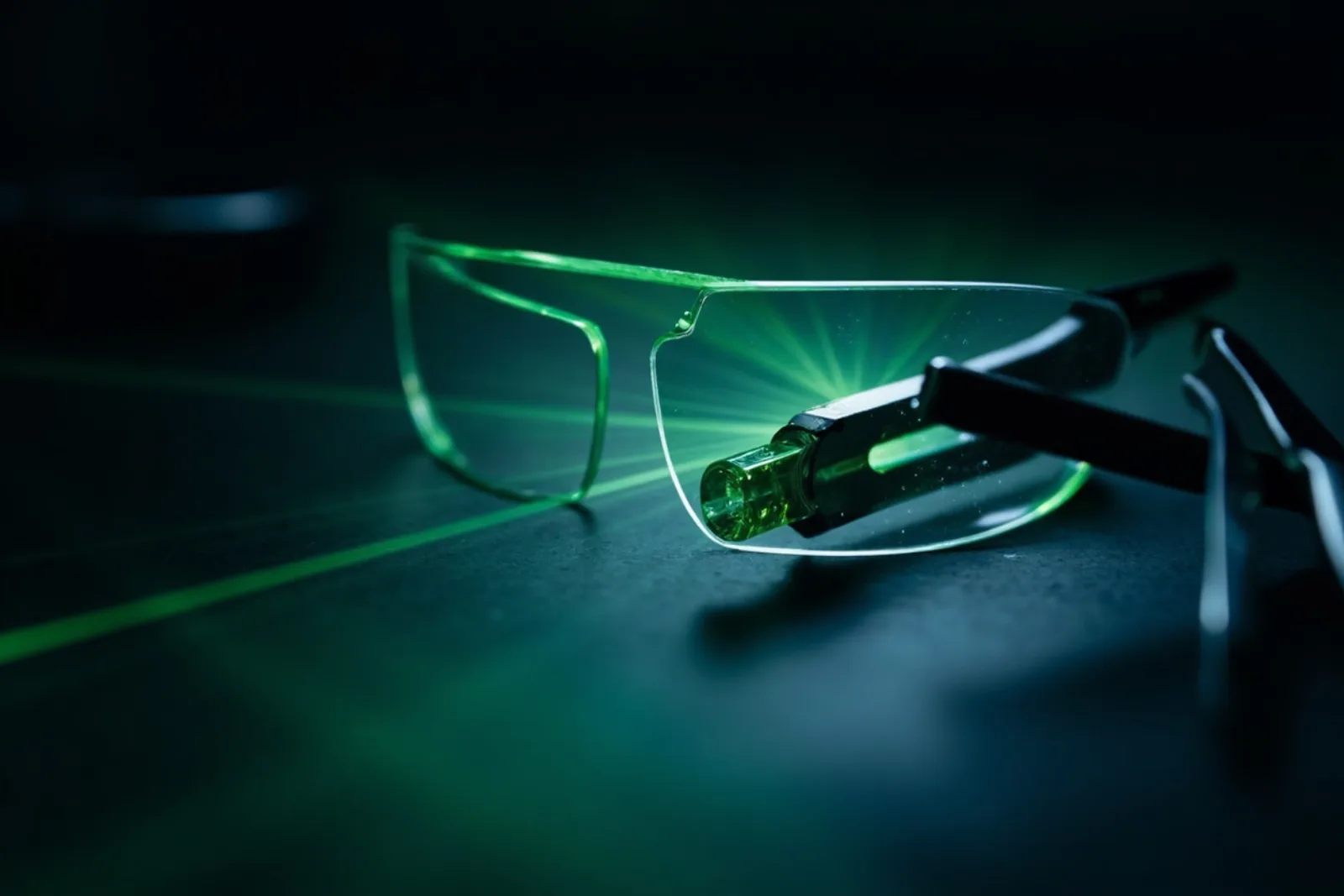
The combiner only moves light; the projector engine creates it. Four technologies account for nearly all current display glasses, and each pairs better with some combiners than others. The projector is also where most display power is spent and most heat is generated.
| Engine | How it images | Strengths | Typical limitations |
|---|---|---|---|
| LCoS | Reflective liquid-crystal on silicon panel illuminated by LED | Mature, full color, good resolution per dollar, broad supplier base | Illumination optics add size; contrast and black level depend on stack |
| DLP | MEMS micromirror array with LED illumination | High speed, good color with sequential fields, proven in production | Engine packaging and speckle-free illumination require design care |
| Micro-LED | Emissive inorganic LED array imaged directly into the combiner | High luminance, small package, low idle power, suits monochrome waveguide glasses | Full-color arrays remain costly and yield-limited at small pitches |
| Laser beam scanning (LBS) | Laser diodes scanned by a moving mirror | High efficiency, always-in-focus character, deep black | Scan engine complexity, speckle, laser safety classification work |
Most thin notification glasses shipping at consumer volume pair a monochrome green Micro-LED engine with a diffractive waveguide because the combination minimizes projector depth and idle power. Full-color multimedia and enterprise products more often pair LCoS or DLP with birdbath or waveguide stacks designed for higher throughput. Asking which projector is best in isolation is the wrong question; the engine, combiner and brightness target are one decision.
Field of view, eyebox, brightness and transparency defined
Four numbers dominate display marketing sheets, and all four need definitions before two products can be compared honestly.
- Field of view (FoV). The angular extent of the virtual image, usually quoted diagonally in degrees. Current see-through consumer glasses typically land in a broad range roughly between 20 and 50 degrees diagonal, with notification products at the lower end and bulkier enterprise designs at the upper. Always ask whether the quoted FoV is monocular or overlapped binocular, and whether it holds across the full eyebox.
- Eyebox. The 3D region in front of the lens where the complete image is visible without clipping. A generous eyebox tolerates face-shape variance, prescription inserts and frames slipping during exercise; a tight one causes image loss with small position changes. Exit-pupil expansion inside the waveguide exists primarily to enlarge it.
- Brightness. Quoted in nits, or candela per square meter, this must be measured at the eye through the combiner, not at the projector face. Outdoor-readable targets require high eye-box luminance because the display competes with daylight; projector output, combiner efficiency and thermal throttling set the real number, so ask for sustained rather than peak luminance.
- Transparency. The percentage of ambient light passing through the lens, comparable to sunglass transmission categories. Very dark combiners look like sunglasses indoors and limit safe use conditions; high-transparency waveguides preserve normal appearance but typically sacrifice image efficiency.
Uniformity and color shift across the eyebox are a fifth, quieter metric: a display that is bright center and green-edged at the periphery fails user acceptance even when the headline numbers look strong.
Manufacturing, yield and the cosmetic acceptance bar
Display optics are where many glasses programs lose margin. Waveguide yield depends on grating fidelity, lamination cleanliness, coating uniformity and the handling of large thin glass parts, while birdbath yield depends on beam-splitter alignment and mirror coating consistency. Even small cosmetic defects, dust inclusions or coating rings sit directly in the wearer field of view, so cosmetic acceptance criteria are stricter than for ordinary sunglass lenses.
Procurement questions should therefore cover yield history on the exact optical stack, documented inspection criteria under controlled lighting, acceptable luminance and color uniformity bands, and whether display modules are bought pre-aligned or aligned in final assembly. Alignment between projector and coupler is micron-sensitive; designs that allow passive, fixture-based alignment scale far better than units needing individual active alignment. Because optical development and tooling run long, display architecture should be fixed early in the schedule described in our development timeline guide.
What to specify in a display glasses RFQ
- Use case and content type: monochrome notifications and captions, full-color navigation, or media viewing, plus day and night use conditions.
- Target FoV with monocular or binocular definition, and minimum usable eyebox dimensions for the intended fit range.
- Combiner preference or openness: geometric waveguide, surface-relief diffractive, volume holographic or birdbath, with frame transparency targets.
- Projector technology acceptance: Micro-LED, LCoS, DLP or LBS, including full-color versus monochrome and outdoor luminance requirements measured at the eye.
- Image quality acceptance: center-to-edge uniformity, color shift, distortion, focus distance and acceptable artifact levels under external sunlight.
- Manufacturing evidence: yield data on the proposed stack, cosmetic inspection standard, alignment method, display power in normal and bright modes, and second-source plans, with cost implications cross-checked against the NRE and tooling cost guide.
Share your target frame style, content type and outdoor-use requirements with CYNRIN through a project quotation request and our optical engineers will propose a combiner and projector pairing with measured FoV, eyebox and power data. To understand the energy side of the tradeoff before locking the stack, read the smart glasses battery life guide next.
Frequently Asked Questions
What is the difference between a diffractive and a geometric waveguide?
Geometric or reflective waveguides bounce light through partially reflective mirrors inside the substrate, giving clean optics with high transparency but at greater thickness and manufacturing complexity. Diffractive waveguides use surface-relief gratings or volume holograms to couple and expand the pupil, enabling thin light lenses with higher yield potential but more color-uniformity and rainbow-artifact work. Both are shipping in current products.
Are birdbath optics better than waveguide displays?
Better depends on the product. Birdbath free-space combiners are mature, relatively low cost, high contrast and tolerant of projector choice, but the curved visor is conspicuous, less transparent and lets more ambient light in. Waveguides suit conventional sunglass silhouettes and all-day wearing, at higher component cost and tighter optical tolerances. Industrial and budget products often favor birdbath; lifestyle eyewear favors waveguide.
What field of view is realistic in smart glasses today?
Commercially realistic diagonal fields of view typically land between roughly 20 and 50 degrees depending on combiner and projector, well below smartphone-like immersion. Monocular notification products often sit near 20 to 30 degrees, while fuller mixed-reality designs push higher at the cost of size, brightness and battery. The useful comparison is binocular FoV at the stated eyebox, not a peak lab number.
Why is eyebox important in smart glasses?
The eyebox is the three-dimensional region where a wearer with normal eyeglass positioning sees the full image. A small eyebox means the display vignettes or disappears when the frames slip down the nose or fit a wider face. Mass-market products need an eyebox generous enough for face-shape variance and safety-lens fitting, which is why exit-pupil expansion is engineered into most waveguides.
Which display technology should I specify for an ODM glasses program?
Start from use case and target frame style, then pick projector and combiner together. Monochrome Micro-LED on a diffractive waveguide suits thin notification glasses; LCoS or DLP suits full-color birdbath products needing lower bill-of-materials risk; LBS suits laser-scanning designs prioritizing efficiency. Ask the ODM for measured FoV, eyebox, luminance uniformity and yield data on the exact optical stack before tooling.