Audio is the feature most first-generation smart glasses customers actually use every day. Listeners take calls, take voice prompts and stream podcasts while keeping their ears open to traffic, conversations and the room around them. That open-ear promise looks simple from the outside, but the acoustic system inside a pair of temples is one of the most tightly constrained problems in wearable engineering: milliwatt-class drivers, a moving head, wind noise at speed, and a wearer who expects call clarity next to a coffee machine.
For a brand sourcing audio smart glasses from an OEM or ODM, the speaker and microphone choices are not interchangeable modules. They couple to the frame geometry, the Bluetooth radio, the battery and the firmware tuning, and they decide return rates more visibly than almost any other subsystem. This guide explains how open-ear acoustics work in current-generation glasses, what the speaker and microphone options trade away, and how to write measurable audio requirements into an RFQ. CYNRIN tunes complete audio chains on reference eyewear platforms, and our customization service covers driver selection, port geometry and call-noise tuning for branded programs.
How open-ear audio works on the face
Conventional earbuds seal the ear canal and create a controlled acoustic volume. Glasses do the opposite: they leave the canal open and aim sound at its entrance from a speaker embedded in the temple tip. The listener hears a mix of reproduced audio and ambient sound, which is the core safety and comfort advantage for cycling, commuting and workplace use.
That open path is unforgiving. Low frequencies diffract around the head and leak away, so honest bass response is limited by physics rather than price. The driver, its chamber, the sound port and the seal of the temple against the side of the head together form one acoustic circuit, and a half-millimeter port change can shift the response several decibels. Fit variability across face shapes and hair styles changes the result further, which is why production tuning targets a robust average rather than a single ideal head. Buyers should expect to evaluate audio on the final frame geometry, not on an engineering demo temple.
Speaker architectures used in smart glasses
Three transducer families dominate shipping products, each balancing output, leakage, size and cost. Some designs add a passive chamber or a secondary leakage-canceling port, and newer directional approaches use paired apertures to create interference patterns aimed at the ear.
| Architecture | Strengths | Tradeoffs | Typical fit |
|---|---|---|---|
| Micro dynamic driver in directed port | Mature, low cost, acceptable speech and music balance | More high-frequency leakage, chamber tuning sensitive | Mainstream audio and calling glasses |
| Balanced-armature style transducer | Small, efficient, clear speech band | Limited bass, narrow response without careful chamber design | Ultra-slim temples, call-first products |
| Directional or dual-aperture acoustic design | Higher directivity, lower measured leakage | More tuning effort, tighter fit sensitivity, higher cost | Premium and privacy-conscious lines |
The trend is toward higher directivity: shaping the wavefront so energy reaches the ear entrance but drops off a short distance away. No current consumer design makes audio inaudible to a nearby person in a silent room, and any supplier claiming total privacy should be asked for leakage measurements, not assertions. Bone conduction appears in some sport-focused products and solves leakage almost completely, but its audible frequency range and sound signature divide listeners, so most lifestyle glasses stay with air-conduction drivers.
Directivity, leakage and real-world loudness
Three measurements separate a credible open-ear product from a disappointing one, and all three should appear in your acceptance criteria.
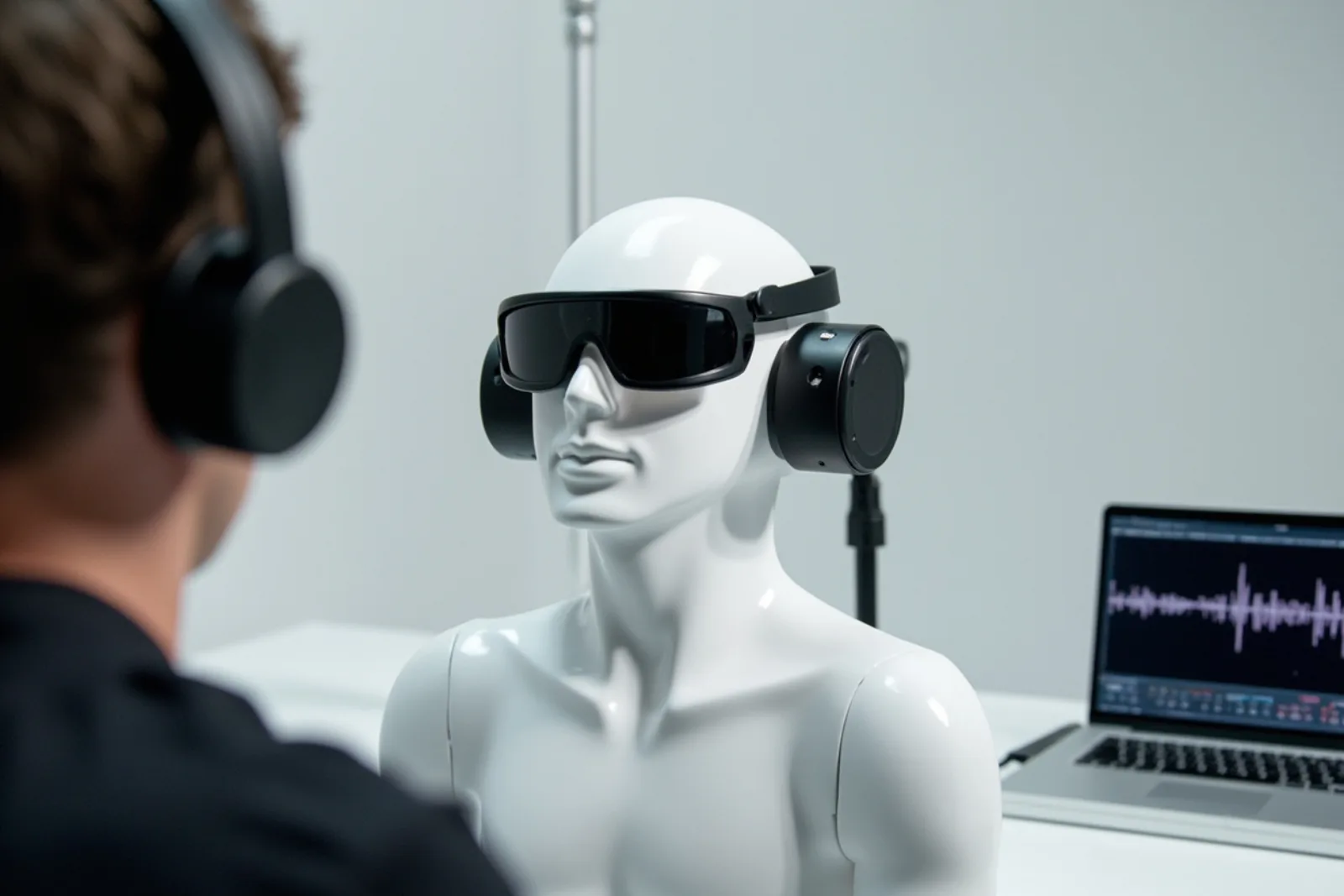
- Sound pressure at the eardrum reference point. Measured on a head and torso simulator, this predicts what the wearer actually hears across frequency. A flat-looking bench response rarely survives placement on a head.
- Leakage at distance. Typically sampled 30 to 50 centimeters away at the shoulder and behind the wearer, leakage curves show how much speech and music a bystander receives. The 1 to 4 kHz range matters most for intelligibility and privacy.
- Maximum output and hearing dose. Open-ear products need surprising peak output to overcome street noise, but sustained high volumes carry hearing-dose implications. Define a maximum SPL cap and an exposure-consistent volume curve with your ODM.
Because the ear remains open, the perceived loudness also depends on ambient noise; users instinctively raise volume outdoors, increasing both drain and leakage. Some platforms add ambient-aware volume limiting. Whatever the feature list, require leakage curves at several volume steps, measured in an anechoic chamber and rechecked on production tooling.

Microphone arrays, beamforming and noise cancellation
The downlink is only half the call. Listeners on the other end judge the product by what the microphones capture, and glasses sit in a difficult acoustic location: close to the mouth but off-axis, exposed to wind across the lens and surrounded by structural vibration from handling.
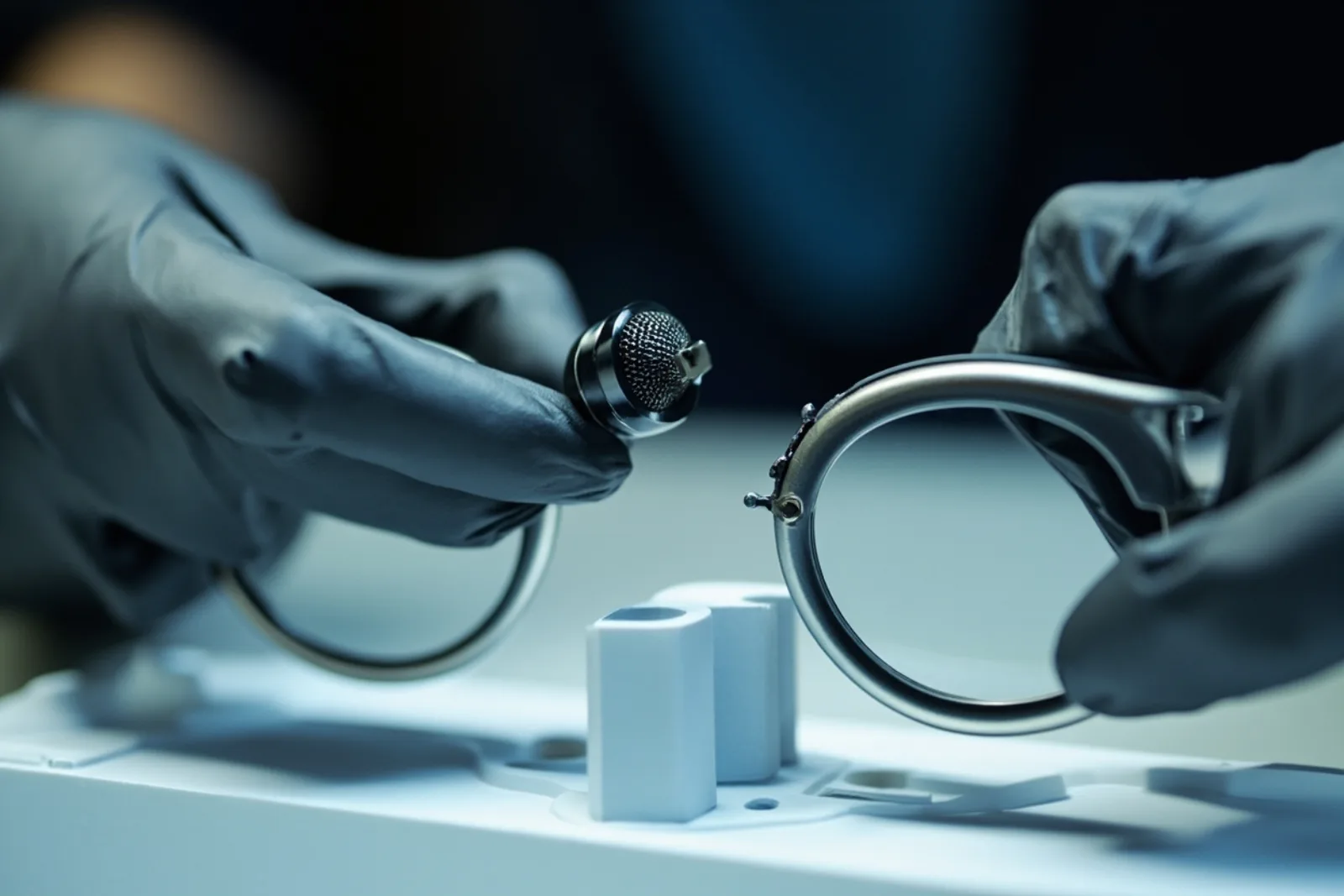
Current-generation call glasses usually carry two or more microphones per side, combining front-facing and rear-facing MEMS elements. A two-mic pair enables a beamforming pattern biased toward the mouth while rejecting sounds arriving from elsewhere; the digital signal processor estimates noise in speech pauses and applies environmental noise cancellation (ENC). Wind is the harder problem because turbulent noise is broadband and partly structural. Effective designs combine mesh-covered ports, mechanical damping, and algorithmic wind detection that switches modes above a threshold; sport and cycling programs should specify tested wind speeds rather than trusting wind-filter claims. The microphone layout also interacts with a camera vision pipeline, since both subsystems compete for temple space and power; our AI camera glasses guide covers that co-design problem. Require call recordings made in staged cafe, office, street and wind conditions, plus double-talk tests so echo cancellation does not clip the speech of the person calling.
Bluetooth, LE Audio and latency budgets
Classic Bluetooth with AAC or SBC streaming remains the interoperable baseline across the installed phone base. LE Audio adds the LC3 codec, lower expected streaming power, multi-link topologies and hearing-accessibility features, and it is increasingly specified on new platforms. LC3 generally delivers better speech intelligibility at low bit rates, which matters for podcast and call battery life, but the improvement is small next to poor source tuning.
Latency deserves explicit attention for products that pair voice prompts with a camera viewfinder or video capture. Audio-for-calls tolerates well over 100 milliseconds, but lipsync with on-glasses recording needs a measured end-to-end budget including the phone and app. Antenna placement is equally important: temples are gripped by hands and dampened by the body, so pairing stability in a pocket-on-the-opposite-side test is a standard check. Radio verification should be treated as a gate, and it sits within the broader quality control and reliability process before mass production.
Tuning, testing and supplier validation
Audio quality is a tuning project with a hardware bill of materials attached. Two products with the same driver and MEMS microphones can sound a generation apart because of chamber design, port meshes, DSP parameter sets and echo-canceller training. During sourcing, ask who owns the tuning, whether the reference tuning is reusable across frame styles, and how many tuning cycles the development agreement includes.
- Insist on head and torso simulator data for response, leakage and maximum output on tooled frames, not mockups.
- Demand objective call-quality evidence: recordings and intelligibility metrics in named noise environments at defined sound levels.
- Check wind performance at stated speeds and verify recovery time after gusts.
- Validate Bluetooth behavior across representative iOS and Android phones, including multipoint and reconnect scenarios.
- Audit consistency in production: driver and microphone parts vary, so line tests must catch shifted frequency response.
What to put in an audio glasses RFQ
A measurable specification forces comparable quotes. Include these items:
- Target use profile: call-first, music and media, sport at speed, or workplace, with expected daily minutes per mode.
- Acoustic targets: frequency response tolerance, maximum SPL cap, and leakage limits at defined distances and volumes.
- Microphone architecture: number and placement of MEMS elements, beamforming expectations, and ENC or wind modes with tested noise and wind levels.
- Wireless requirements: Bluetooth version, LE Audio support, required codecs, multipoint, latency in capture use cases, and a handset compatibility list.
- Validation deliverables: head simulator reports, staged-noise call samples, over-the-air radio reports, and production line acoustic test methods.
- Program constraints: target temple thickness, battery budget per mode, and the audio portion of the power targets in our battery life guide.
Send CYNRIN your acoustic targets and target frame geometry through a quotation and engineering request and we will match a speaker and microphone platform with tuning data you can evaluate against your own call-quality bar. If your roadmap adds a camera, review the camera and on-device AI guide alongside this one, since the two RFQs should be written together.
Frequently Asked Questions
What are open-ear smart glasses and are they safe for hearing?
Open-ear glasses leave the ear canal unblocked and direct sound toward its entrance, so situational hearing stays intact and in-ear pressure injuries are avoided. Safety depends mainly on exposure levels: even open-ear drivers can exceed recommended doses at high volume for long periods. Reputable OEMs cap output and test maximum sound pressure against consumer-audio norms.
How much do other people hear from audio glasses?
Some leakage is unavoidable because the ear canal stays open; it is most audible in quiet rooms and rises quickly with volume. Directional speaker designs, baffles and port geometry substantially reduce mid-range spill at conversational levels. Leakage must be measured on a head and torso simulator at fixed distances rather than judged subjectively in a showroom.
How many microphones do smart glasses actually need?
One microphone covers basic monaural calls in still air, while two microphones per side, front and rear, are the common arrangement for beamforming and environmental noise cancellation. Three-microphone arrays add wind handling and broader pickup but cost more in board space, power and tuning effort. The deciding factor is your wind-noise and street-noise acceptance criteria.
Does Bluetooth LE Audio improve glasses call quality?
LE Audio brings lower streaming power, the LC3 codec and multi-stream audio, which helps battery life and stereo call behavior. It does not fix a weak antenna, poor microphone placement or undertuned echo cancellation, and listeners on classic Bluetooth phones still use the legacy path. Specify both paths and require over-the-air testing with representative handsets.
How do I verify audio quality before approving a glasses design?
Require head and torso simulator measurements for frequency response, leakage curves and maximum output, plus recorded call samples in staged wind, cafe and traffic noise at defined levels. A-weighted speech intelligibility scores and double-talk echo tests give objective pass-fail data. Validate on final tooled frames because acoustic ports change with every housing revision.